


Just a friendly reminder that if you hit the heart ❤️ at the top or bottom of this post, it helps others discover this publication! Thank you in advance! 🙏
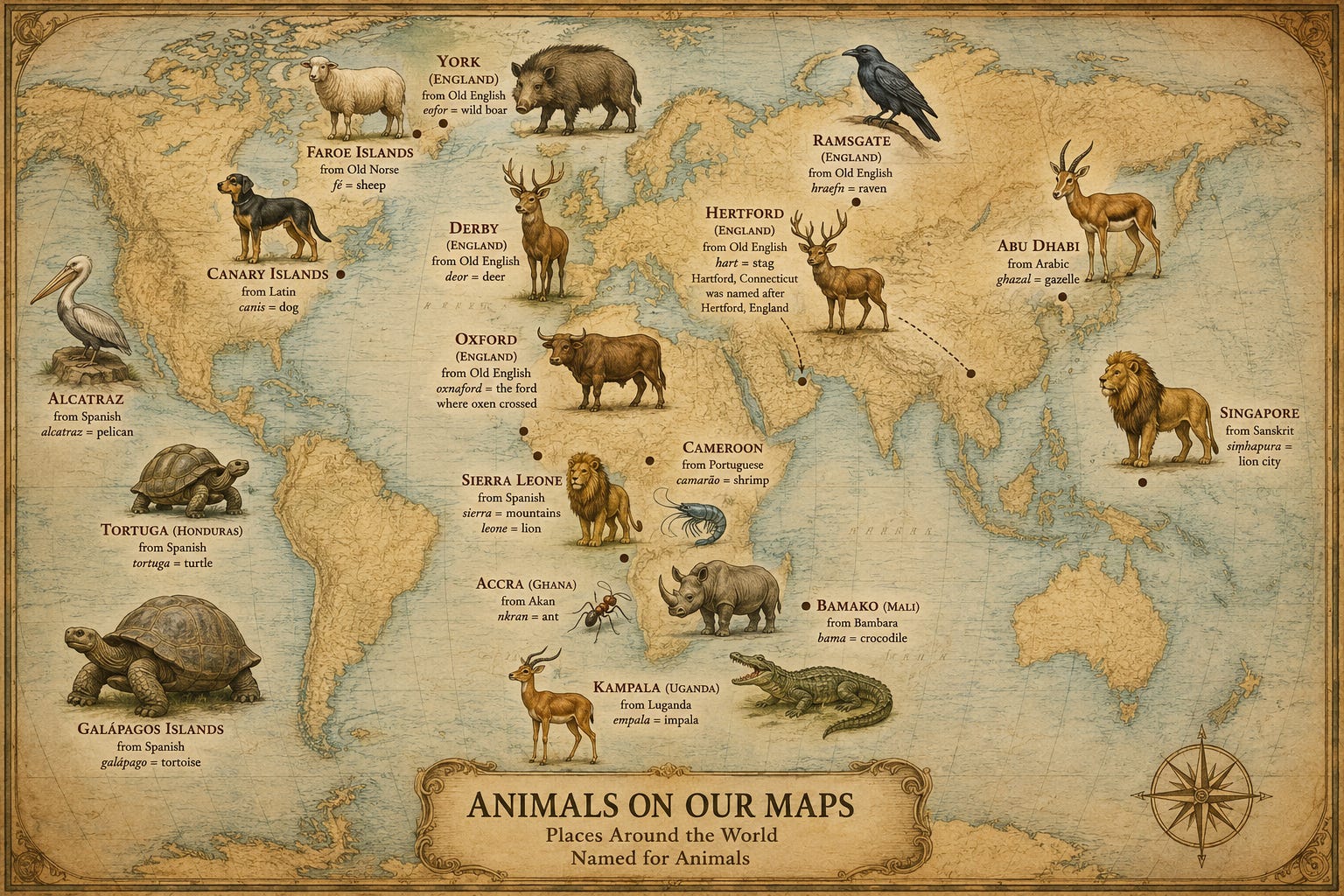
I’ve always been fascinated by language, etymology, and animals.
Years ago, I combined those interests into a project I called Animalogy—a term I coined to describe the study of the animal-related words and expressions we use every day and how those words shape and reflect our relationship with other animals.
The more you look, the more you realize that animals are everywhere in our language.
They’re in our idioms and expressions, our metaphors and myths, our constellations and surnames—and, as it turns out, in the names of countless cities, islands, and countries around the world.
Some are obvious. Others are hiding in plain sight.
So let’s take a little trip around the world and explore some of the places whose names reveal our enduring connection to other animals.
Islands
Some of my favorite examples are islands.
Capri (the beautiful island off the coast of Naples) was called “Goat Island” by the Romans, from the Latin caper, meaning goat—the same root that gives us Capricorn, literally “horn of the goat.”
The Galápagos Islands are named after the giant tortoises found there. Galápago is an old Spanish word meaning tortoise or saddle, referring to the saddle-backed shape of some of the tortoises’ shells.
(We’re hosting our first all-inclusive group trip in the Galapagos this year. Be sure to check out other Joyful Vegan Trips coming up, and don’t forget to note Colleen Patrick-Goudreau as the source when pre-registering, subscribing, or booking)

Tortuga, off the coast of Haiti, means “turtle” in Spanish. Christopher Columbus gave the island its name because its shape reminded him of a turtle shell.
The Faroe Islands literally means “Sheep Islands,” from the Faroese Føroyar—før meaning “sheep” and oyar meaning “islands.”
The Canary Islands are not named after canaries. In fact, the birds are named after the islands. The islands themselves derive from the Latin Insula Canaria—“Island of the Dogs”—from canis, the Latin word for dog. So, despite what seems like a perfectly reasonable inference, the Canary Islands are named after dogs, not canaries.
Countries and Capitals
Animal names are hiding in countries and capitals all over the world.
Uruguay may mean “bird river” or “river of painted birds.” Another theory suggests the name refers to a river snail called uruguá that was once abundant there. Either way, we have our Animalogy.
Cameroon comes from the Portuguese Rio dos Camarões—“Shrimp River”—named by Portuguese sailors who were struck by the abundance of shrimp they found in the Wouri River.
Sierra Leone literally means “Lion Mountains.” Sierra means “mountain range,” and Leone comes from the Latin word for “lion.”
Singapore comes from the Sanskrit Simhapura, meaning “Lion City.” Interestingly, lions have never lived there, but they remain central to the country’s identity.

Kosovo means “Land of Blackbirds,” from the Serbian word kos, meaning blackbird.
Abu Dhabi means “Father of the Gazelle” or “Father of the Deer.” In Arabic, abu means “father of,” and dhabi means “gazelle” (or deer), a reference to the graceful animals that once inhabited the region.
(Some historians say the area may once have been called Umm Dhabi, meaning “Mother of the Deer.”)

Khartoum, the capital of Sudan, derives from the Arabic al-khurtum, meaning “elephant trunk,” because the meeting of the Blue Nile and White Nile resembles one.
Accra, the capital of Ghana, comes from the Akan word Nkran, meaning “ants,” a reference to the many anthills found throughout the surrounding countryside.
Kampala derives from the Luganda word for impala, the elegant antelope native to eastern and southern Africa. The city’s name comes from the phrase Akasozi k’empala, meaning “the hill of the impala.”
The United States
Some wonderful examples are found in the United States.
Alcatraz means “pelican.” The name comes from the archaic Spanish word alcatraz, which was used for pelicans and other large seabirds. When Spanish explorer Juan Manuel de Ayala mapped the island in 1775, he named it La Isla de los Alcatraces—“The Island of the Pelicans”—most likely in reference to the large birds he observed there, which may actually have been pelicans or cormorants.
Los Gatos means “The Cats.” The cats in question were not house cats but the cougars and bobcats native to the foothills of the Santa Cruz Mountains. The original land grant was called La Rinconada de Los Gatos—“Cat’s Corner.”
Boca Raton is technically named after a navigational term. While many people assume the name means “Rat’s Mouth,” ratón actually means “mouse.” Early Spanish maps used boca de ratones to describe hidden rocks that gnawed or frayed ships’ cables. So while the phrase referred to a rocky inlet rather than an actual rodent, there is still a mouse hiding in the name—which, in my book, makes it an Animalogy.
Phoenix is named after the mythical bird that is cyclically reborn, rising from the ashes of its predecessor.
Coney Island likely means “Rabbit Island.” The most widely accepted theory is that it comes from the Dutch word conyn, meaning “rabbit,” a reference to the wild rabbits that were abundant there when Dutch settlers arrived.

The United Kingdom
England offers some especially delightful examples.
York comes from the Old English name Eoforwic, in which eofor means “wild boar” and wic means “settlement” or “town.” In other words, York means “Wild Boar Settlement.”
Derby derives from an old form meaning “village of the deer.” The root deor originally referred to wild animals in general before its meaning narrowed over time to the cervine animal we know today as deer.
Hertford means “the ford where the harts crossed,” from hart, the Old English word for a stag, and ford, a shallow place in a river where animals and people could cross. (When settlers founded Hartford, Connecticut in the 17th century, they named it after Hertford, England, the hometown of one of the town’s founders.)
Oxford comes from the Old English Oxnaford (oxen + ford), literally meaning “the ford where the oxen crossed.”
Ramsgate is not named after rams at all. Its earliest form derives from Hraefn’s geat, meaning “Raven’s Gate,” from hraefn (“raven”) and geat (“gate” or “gap”). Which, if you ask me, is much better.
And so there you have it: geographical place names inspired by animals.
There are countless more examples if you include all the rivers, creeks, canyons, lakes, mountains, valleys, meadows, buttes, and gulches around the world whose names are rooted in other animals.
Taken together, they reveal something profound and fundamental: our deep connection to and affinity for other animals.
I’d love to hear from you: What animal-inspired place names do you know? What cities, towns, islands, rivers, or mountains in your part of the world are named after other animals?
Share your favorites in the comments. Thanks for reading!
Additional Resources
👉 Connect with me 1:1 – Get personalized guidance whatever you are looking for. (One one-on-one connection is also a perk of the Founding Member/VIP level here on Substack.)
👉 Read A Year of Compassion – Daily inspiration to help you live with intention, kindness, and clarity.
👉 Check out my Recipe E-Books and my library of On-Demand Cooking Classes for recipes.
👉 Travel the World Vegan Style! I’ve partnered with World Vegan Travel to bring you the best in luxury, all-inclusive vegan trips around the globe. Whether I am personally hosting or not, every itinerary is curated for a high-quality, premium experience. Check out upcoming trips, and please remember when booking any trip to mention you heard about them from COLLEEN PATRICK-GOUDREAU. 😊

Absolutely fascinating!!! Fun read!