


Just a friendly reminder that if you hit the heart ❤️ at the top or bottom of this post, it helps others discover this publication! Thank you in advance! 🙏
Whether you’re a vegan navigating the inevitable grey areas, or a non-vegan who has ever been confused by why some vegans police each other, why some “vegans eat meat,” or what the word even means—this article is for you. Today, we look at what counts as vegan, what doesn’t, and who gets to decide. We explore how the simple intention to prevent animal cruelty can quickly turn into a rigid purity test—one that confuses the public, distracts from the core mission, and pushes people away from making compassionate choices.
The Origins and Evolution of “Vegan”
When most people hear the word “vegan,” they have a general idea of what it means: in short, someone who doesn’t eat or wear anything that comes out of or off of an animal. That’s usually where it ends for most people; either they don’t give it much more thought than that or they’re still confused by what it means because they’ve met some vegans who eat animals…occasionally.
When the term vegan was coined in 1944 by the founders of The Vegan Society in the UK, it was created to distinguish those who avoided dairy and eggs from general vegetarians. The word itself comes from vegetarian, taking the beginning — veg — and the end — an — to form a new term. At the time, the definition was much narrower and primarily dietary.
Early on, veganism was essentially defined as avoiding
meat
dairy
eggs
While the original focus was on dietary exclusion, the definition expanded to include clothing (leather, wool, silk), testing on animals, entertainment, and other uses. The modern definition reflects that expansion.
Seems straightforward enough. Except it’s not.
Why? Because we’re complex beings living in a complex world — and not everything is as it seems. Or at least, not everything is black and white. Some things are grey, especially once you make the leap from eating and wearing animal products to not.
For instance,
What about plant-based foods made on the same equipment as animal products? Is that vegan?
What about a plant-based burger cooked on the same grill as meat? Is that vegan?
What about almonds and avocados pollinated by bees who have been rented out to farmers? Is that vegan?
What about needing to take medications or vaccines that would have been tested on animals? Is that vegan?
What about eating white sugar that’s been processed using animal bones? Is that vegan?
What about taking vitamin D3, which is often sourced from lanolin? Is that vegan?
What about kissing someone who eats meat? Is that vegan?
What about accidentally inhaling bacon fumes? Is that vegan?
See what I mean? Lots of grey.
There is No Vegan Scoutmaster
People “become vegan” for different reasons, but they usually fall into a few broad categories:
Protecting animals from cruelty or violence
Protecting the environment
Improving their health.
Depending on which category someone falls into, their definition of vegan may differ a bit.
Why? Because “becoming vegan” is not like joining a club, getting a handbook, and earning merit badges. This isn’t the boy scouts (or girl scouts). There’s no initiation. There’s no oath. There’s no pledge of allegiance.
And — to further our Boy Scout analogy — there’s no Scoutmaster. No one is in charge of enforcing standards, keeping score, or determining whether you’re doing veganism “correctly” — except, of course, the people who appoint themselves to that role to police other vegans.
Becoming vegan isn’t like joining a club, getting a handbook, and earning merit badges. There’s no initiation. There’s no oath. There’s no pledge of allegiance.
Becoming vegan" isn’t about dogma or doctrine. Once you awaken to the horrific things humans do to animals for our pleasure and convenience, it is deeply unpleasant—and you simply don’t want to be a part of it. So you align your behavior with your values and become vegan.
But the goal is not to “be vegan.” The goal is simply to stop contributing to that harm.
And then, after living in the real world for a while, you start running into tricky situations and grey areas and wonder whether it’s even possible to be vegan at all.
You learn that red food coloring comes from crushed insects (cochineal), that animal bones are used to filter drinking water, and that slaughterhouse waste is used in commercial potting soil.
At that point, several things could happen:
You realize that being vegan isn’t about being perfect, that this is an imperfect world, and you simply go about your vegan life.
Or you stop being vegan altogether because you think you have to be perfect if you’re going to do anything at all.
Or you begin policing themselves, other vegans, and the world for not living up to the vegan purity standards you’ve set — and, not surprisingly, you become cranky, cynical, and anti-social. (Despite your dogmatism, you might even stop begin vegan.)
Cruelty vs. Purity: The Coconut Milk Lesson
These grey areas usually come down to how far it’s reasonable—or even possible—to entirely avoid causing suffering. But they also come down to how we frame a product or a person as “vegan” or “not vegan.”
Take coconut milk, for example. It is a milk derived entirely from coconuts—100% plant-based. 100% plant-derived. Yet, investigations have revealed that some producers, particularly in Thailand, subject pig-tailed macaque monkeys to unendurable torment, capturing them from the wild and forcing them to chain-harvest coconuts.
Terrible, horrible, cruel. On that point, there is no argument.
But in response, many vegans declare that “coconut milk isn’t vegan.”
On that point, I completely disagree.
Capturing and chaining wild monkeys to harvest a commercial product is an animal cruelty issue that is incumbent upon all of us to solve—whether we are vegan or not. It is not a “vegan issue” for vegans to manage through consumer avoidance.
When we label an entire food category as “not vegan,” it reduces a systemic horror into a personal limitation. It makes it sound like yet another rigid, exclusionary rule vegans have to live by—and it leaves the general public completely confused about what “vegan” even means.
The truth is anyone can care about ending animal cruelty without being vegan. But the moment we label coconut milk itself as “not vegan,” we create unnecessary barriers and accidentally imply that the torture of these monkeys is an exclusive issue for a small subculture to worry about.
If instead we explicitly state that “some brands of coconut milk hurt animals,” people are far more likely to listen, learn, and boycott. Animal cruelty is a universal human concern.
(Anticipating some vegans’ reaction to that last sentence, yes, people can indeed care about animals and not be vegan. It’s called willful ignorance, and it is a very human strategy for reconciling the cognitive dissonance we experience when we eat animals while simultaneously caring about them. To dive deeper into how we navigate these psychological blocks, see my book, The Joyful Vegan or my article, Why We Eat Meat, Dairy, and Eggs.)
Drawing Personal Lines in a Non-Vegan World
Another grey area is so-called “cross-contamination.”
Is a plant-based burger still suitable for vegans if it’s cooked on the same grill as an animal-meat burger?
And what about buying plant-based food at fast-food restaurants like Burger King or KFC — is that “vegan,” given that these restaurants exist primarily to sell animal products?
For me, the question isn’t “is it vegan?” or whether someone is “still vegan” after doing either of the above. The better question is, “Is this suitable for me — for this vegan?” Every single vegan needs to decide what their own comfort level is.
Veganism isn’t a set of dietary laws like Kashrut in Judaism, the system that governs which foods Jews may eat and how those foods must be prepared. That’s not what veganism is about.
Definitions are tools for clarity, not control.
Definitions guide; they don’t govern.
A definition is a map, not a police force.
If we keep that in mind, we’re far more likely to move in the direction of progress.

Adhering rigidly to a definition that doesn’t account for nuance or real-world complexity veers into fundamentalism, and I think that’s a genuine danger among vegans, because it shifts the focus from reducing harm and living compassionately to enforcing purity, which ultimately pushes people away rather than bringing them closer.
The problem isn’t that vegans aren’t vegan if they eat peanut butter, drink water, or eat sugar that had some remote contact with animal products.
The problem is that because so many billions of animals are slaughtered every year, it’s super cheap to use slaughterhouse waste as filler and processing agents.
The focus should remain on the fact that billions of animals are brought into this world only to be killed. That’s a problem we need to address—not whether a vegan (or a product) passes the purity test.
The more animals killed, the more by-products there are, and the cheaper they can be sold for. The fewer animals killed, the fewer and more expensive the by-products—the higher the likelihood that companies will look for cheaper alternatives.
In other words, stop focusing on the inherent imperfection of this thing called “vegan” and focus instead on making more imperfect vegans. To borrow from whoever said something similar: we don’t need a few vegans doing it perfectly; we need a huge number of vegans doing it imperfectly.
The problem isn’t that vegans aren’t vegan if they eat peanut butter, drink water, or eat sugar that had some remote contact with animal products. The problem is that because so many billions of animals are slaughtered every year, it’s super cheap to use slaughterhouse waste as filler and processing agents.
The Reality of Living in an Imperfect World
While there are grey areas in terms of what is or isn’t vegan, there are also clear-cut lines, and I never grapple with them.
For instance, if I intentionally eat animal flesh and fluids, that’s not vegan. If, however, I eat a plant-based option at a fast-food restaurant, that does not undermine my being vegan. I am not eating animal flesh, fluids, or ferments.
Yes, vegan means something. It means doing our best to avoid contributing to violence or harm, to the extent that is possible and practicable. But it doesn’t require a strict rulebook to police every edge case.
And those grey areas? Those are personal boundaries everyone gets to draw. A choice like eating a plant-based meal at a fast-food restaurant may be unappealing to you, and that’s your prerogative—just as it’s another person’s choice to do otherwise.
Veganism is a means to an end (compassion and wellness), not an end in itself. The point is not to be vegan or to obtain a vegan badge. The goal is not to be as vegan as we can be. The goal is to live as compassionately and healthfully as we can, and veganism happens to be a pretty effective (and joyful) way to attain that goal.
The problem is not that we’re imperfect vegans. The problem is that we bring billions of animals into this world only to take them out of it—wreaking havoc on the animals, on our health, on our ecosystems, and on our hearts.
The Questions We Should Actually Be Asking
The questions I’d rather we be asking are:
What will make it easier for people to eat fewer animal flesh and fluids?
What persuades non-vegans to displace animal-based meat—at least sometimes— with plant-based options?
What are ways I can provide support and guidance to people who want to eat fewer animal products, even if they’re not ready to go all the way yet?
And remember: Don’t do nothing because you can’t do everything. Do something. Anything.

Additional Resources
👉 Read The Joyful Vegan! My wish is that every vegan would read this book — to help explain the how’s and why’s of veganism (and avoidance of veganism). Buy signed copies here or regular copies here (or wherever books are sold).
👉 Connect with me 1:1 – Get personalized guidance whatever you are looking for. (One one-on-one connection is also a perk of the Founding Member/VIP level here on Substack.)
👉 Check out my Recipe E-Books and my library of On-Demand Cooking Classes for recipes.
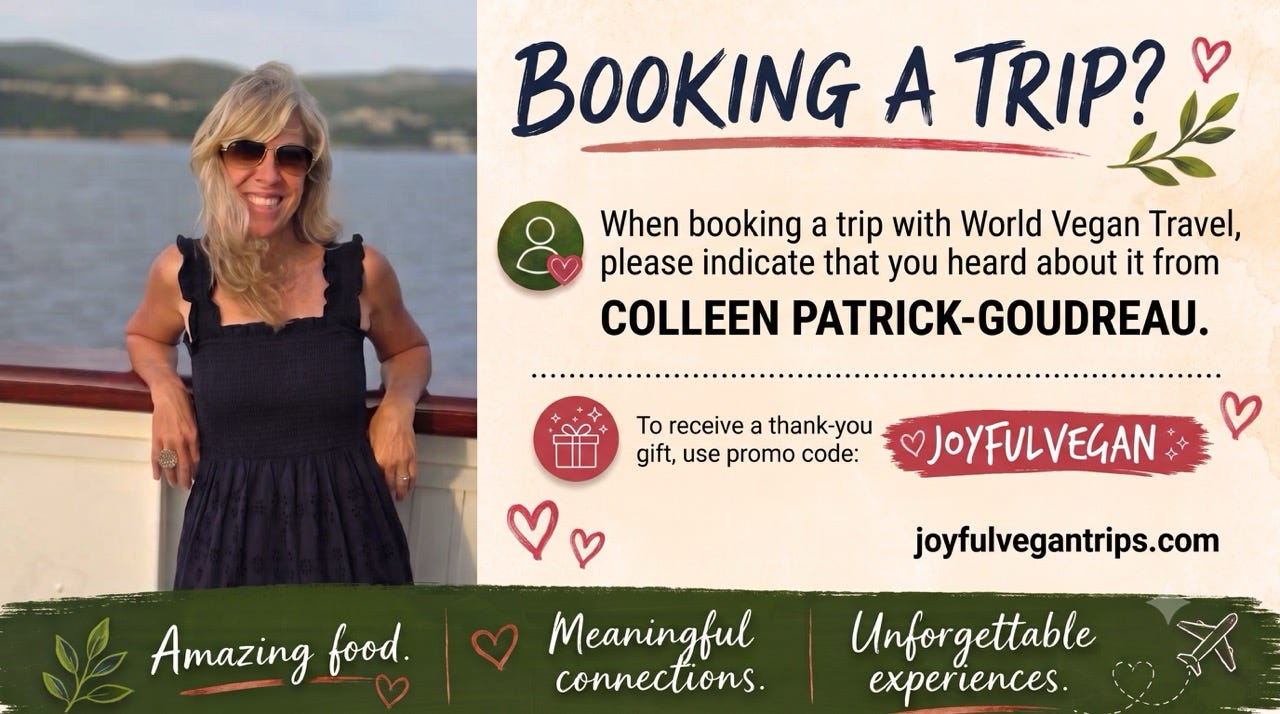
👉 Travel the World Vegan Style! I’ve partnered with World Vegan Travel to bring you the best in luxury, all-inclusive vegan trips around the globe. Whether I am personally hosting or not, every itinerary is curated for a high-quality, premium experience. Check out upcoming trips, and please remember when booking any trip to mention you heard about them from Colleen Patrick-Goudreau, and enter JOYFULVEGAN as the promo code. 😊
My Favorite Supplements
Even with a nutrient-rich plant-based diet, we can thrive even more with thoughtful support. That’s where Complement comes in, I take Complement Essential as my daily multivitamin for B12, D3, iodine, zinc, and magnesium; Omega Complex for essential fats; and as part of my strength-training and muscle-building routine, I fuel up with their clean Organic Protein. With Complement and my nutrient-rich diet, I have everything I need to fuel my body, support my strength, and thrive so I can do my work in the world for animals — both human and non-human.