If you’re enjoying my articles and want to help this publication grow so we can reach more people, please take a moment to comment, heart, or share this post. For the animals, thank you! ❤️
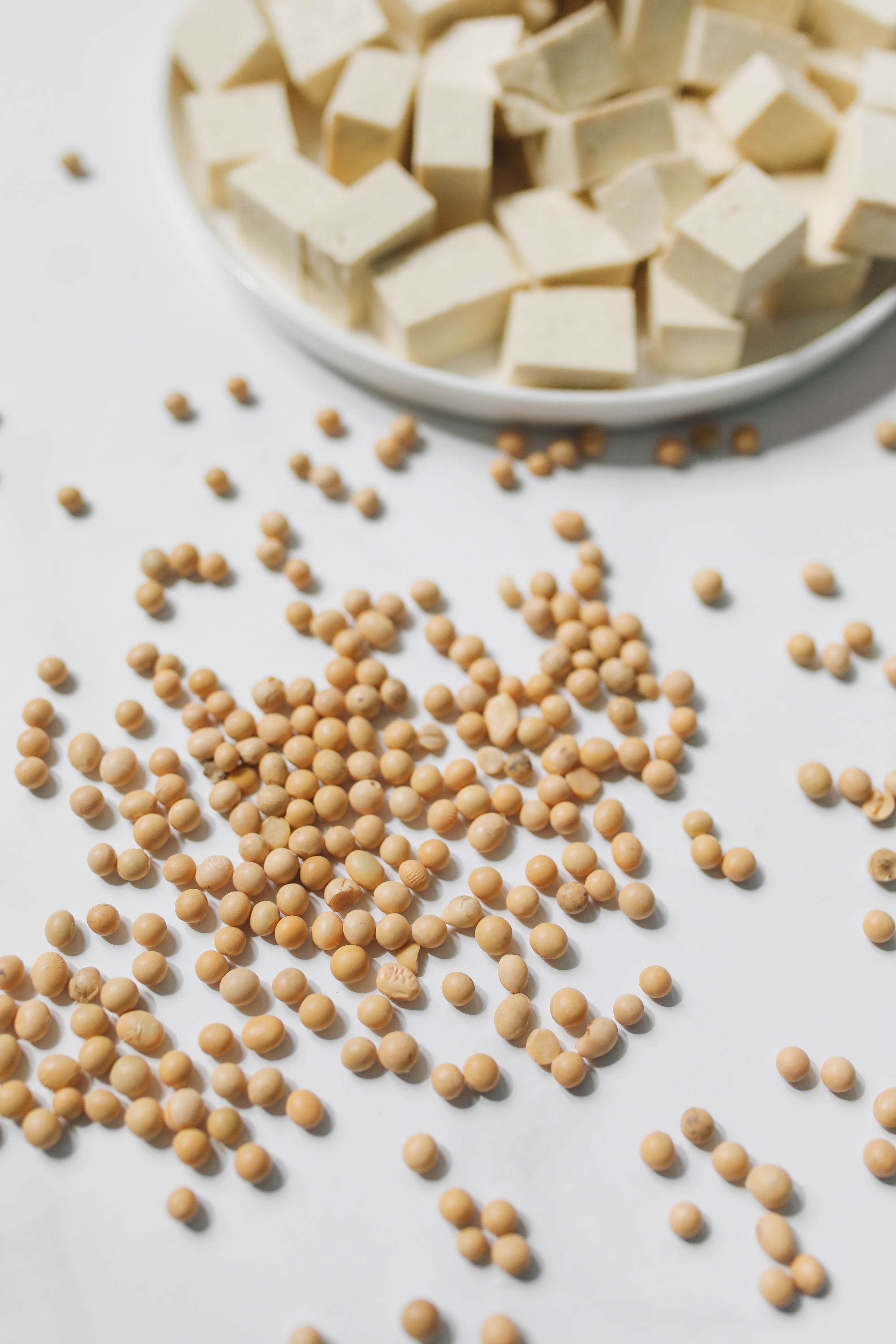
Depending on where and how you grew up, you may or may not have eaten much soy at all. If you didn’t grow up in an East Asian household or in a culture where tofu, tempeh, miso, natto, edamame, and soy milk were everyday staples, soy may have felt (or still feel) unfamiliar. Many of us in the West simply didn’t grow up with these foods; we didn’t learn how to cook them, and we didn’t learn about their nutritional value.
What’s fascinating—and frustrating—is how soy has become one of the most misunderstood foods in the Western world. Over the past few decades, soy went from being praised as a protein-packed, heart-healthy, anti-inflammatory food (a reputation born during the health craze of the 1960s when it first gained traction in the West) to being actively vilified.
Claims that soy “causes breast cancer,” “disrupts hormones,” or “gives men ‘man-boobs’” have circulated widely, alongside fears that it negatively impacts thyroid function, drives environmental destruction in the Amazon, inhibits nutrient absorption, or is just plain bland and tasteless. All of these assertions have taken on a life of their own despite being completely unsupported—or directly contradicted—by actual scientific research and real-world data.
In this two-part series, we are going to unpack the science, the myths, and the culinary reality of this incredible food.
Disclaimer: This article is for informational purposes only and is not intended to replace professional medical advice, diagnosis, or treatment. Always consult a qualified healthcare provider with any questions you may have regarding your health.
More Than Just "Food for Vegans"
I wish I could remember the first time I tried tofu. I certainly didn’t grow up eating it—my childhood table in New Jersey was filled with traditional staples like meat, dairy, and eggs. For many of us in the West, soy foods simply weren’t part of our upbringing.

Instead, they carry a heavy association with vegetarianism and veganism. For me—and I’m sure for many others—it wasn’t until I became vegan that tofu even entered my life. But viewing soy strictly through this lens does it a huge disservice, because people dismiss it as a food “only for vegans or vegetarians.” In fact, people still say to me all the time, “Well, I could never be vegan because I don’t like tofu.”
And of course, I tell them, “You don’t have to eat tofu to be vegan! It’s not a prerequisite.” (Having said that, one of the unexpected joys of becoming vegan is that your culinary world expands, as I discuss in The Joyful Vegan, so you tend to try things you never tried before.)
This hyper-focus on tofu as a strict “vegan substitute” is a uniquely Western viewpoint. If you grow up in China, Korea, or Japan, soy is simply part of the everyday landscape—historically, culturally, and culinarily. In many East and Southeast Asian traditions, tofu is traditionally seen as a complement to animal meat rather than a replacement for it.
In Chinese and Korean cooking, tofu frequently appears in meat-based broths, stir-fries, and stews.
In Japanese, Thai, and Vietnamese cuisines, it is often served alongside fish-based broths like dashi, alongside a strong tradition of tofu-centered vegetarian dishes rooted in Buddhist temple cuisine (shōjin ryōri).
But in the West, soy is seen as “a vegan food.” We need to change the framing.
Soy is food. It is a bean—an ancient, traditional, highly nutritious, and incredibly versatile bean. A bean that needs better PR.
Right now, soy’s reputation completely depends on who you ask. It has been a deeply polarizing food for decades, with a “debate” driven by marketing, social media influencers, and trends rather than sound science. When you look at how it gets misrepresented, the bad PR generally falls into three specific areas:
its environmental impact
its taste
its effect on our health
Let's start with the most prevalent myth regarding its environmental footprint.
The Deforestation Myth
When we hear about soy driving deforestation in places like the Amazon, it’s not the soy in your tofu or edamame that’s the problem—it’s the soy grown to feed billions of farmed animals.

The reality is that the largest use of soy, both globally and in the U.S., is not for human food at all. It’s for animal feed. Roughly three-quarters of all soy grown worldwide is fed directly to chickens, pigs, and cows raised for meat, dairy, and eggs—not eaten directly by humans. In the U.S., that percentage is even higher.
Only about 7% of global soy is used for human food products like tofu, tempeh, and soy milk. The massive demand for animal products is the primary driver of soy-related deforestation in the Amazon and other ecosystems. It’s not because of a high demand for tofu.
The high demand for animal products is the primary driver of soy-related deforestation in the Amazon and other ecosystems. It’s not because of a high demand for tofu.
Furthermore, soy used for human consumption in the U.S. and Europe is often grown domestically in North America or within Europe, under different land-clearing regulations than the Amazon basin. Soy sourced from Brazil or Argentina carries a higher risk of being linked to deforestation, unless it has specific sustainability certifications.
So, to be clear: soy grown for human consumption is most likely from the U.S. (you can check your labels) and is not responsible for clear-cutting forests. If you're looking at what actually drives that deforestation, it's beef—not tofu.
Now that we’ve cleared up the environmental misconceptions, let’s look at the second major area where soy gets completely misrepresented: its taste.
The “Bland and Boring” Myth

On the culinary side of its bad PR, soy—especially tofu—is often dismissed as bland, spongy, or tasteless. But soy is a blank canvas. It actually has a beautiful, subtle, nutty flavor all its own—a delicate nuance that you may simply be unfamiliar with because it isn’t what you grew up eating.
What’s more, if your palate is accustomed to being constantly coated with the heavy fat and intense salt that comes with eating meat and dairy, those subtle flavors can be hard to pick up on. Like any new food, it takes getting used to, but personally, I love tofu so much that I honestly eat it straight out of the package.
Beyond its flavor, the texture of tofu is a total shape-shifter. It is incredibly versatile because of how you can manipulate its texture: it can be cubed, fried, coated, pressed, frozen, or crumbled. It adapts entirely to how you prepare it, how you cook it, and what you pair it with.
Because it is such an incredible canvas, there are endless recipes out there to play with. Of course, doing the work I do, I have developed dozens of ways to prepare it, and while you can always find recipes in my cookbooks, I also have a variety of digital resources available in my online store, including several on-demand cooking classes and recipe bundles, including:
And of course, my brand-new recipe ebook: High-Protein Recipes Featuring Tofu, Tempeh, and Edamame.
Now let’s get to the third area where soy gets misrepresented (which I’ll also continue in Part Two).
The Nutritional Truth
Soy has been evaluated in thousands of studies—including epidemiological, human clinical, observational, and laboratory research—and the science is clear. Soy is a nutritional powerhouse for three big reasons: 1. it’s a plant food, 2. it’s a bean, and 3. it contains unique compounds you don’t find in most other foods, such as isoflavones and phytoestrogens.
First and foremost, soy is a whole plant food. That means it naturally contains zero cholesterol and is exceptionally low in saturated fat, instantly distinguishing it from animal-derived proteins. It also delivers a robust amount of dietary fiber, which is crucial for gut health, metabolic function, and satiety—a nutrient that is entirely missing from meat, dairy, and eggs.
As a member of the bean family, soy inherits all the classic benefits of legumes. It provides a slow release of complex carbohydrates alongside essential minerals like iron, calcium, magnesium, and potassium, making it an inherently stabilizing, nutrient-dense food.
Where soy truly stands out from other beans is its protein quality. It is a complete protein, meaning it provides all nine essential amino acids (those we need from food) in optimal proportions on its own. Its amino acid profile directly rivals animal protein, but without the dietary baggage.
Furthermore, soy is rich in branched-chain amino acids (BCAAs), specifically leucine, which acts as the primary trigger for muscle protein synthesis and repair. Many plant proteins are low in leucine, but soy actually provides a meaningful amount:
1 cup Tempeh: ~3.0 grams of leucine (the optimal muscle-building target)
1 cup Tofu: ~2.0 grams of leucine
1 cup Edamame: ~1.5 grams of leucine
1 cup Soy Milk: ~0.8 grams of leucine
Finally, what truly sets soy apart from every other bean on the planet is its signature concentration of specific phytonutrients called isoflavones. Soybeans contain hundreds of times more isoflavones than other legumes, acting as powerful compounds that help reduce inflammation and protect cells from damage.
But these compounds have a unique property—one that has been wildly misunderstood and blown out of proportion, yet is the exact reason why soy is so uniquely protective.
Because there is so much confusion around this specific topic, we are going to give it the space it deserves. In Part 2, we will dive deep into the actual science behind these compounds and dismantle the most common health scares face-to-face.
We’ll look at exactly what the data says about thyroid health, nutrient absorption, and the ultimate hormone myths—including breast cancer risks and the ridiculous claims about “man-boobs.”
Stay tuned for the full breakdown in Part Two.
Before You Go…
Even with a nutrient-rich plant-based diet, we can thrive even more with thoughtful support. That’s where Complement comes in, I take Complement Essential as my daily multivitamin for B12, D3, iodine, zinc, and magnesium; Omega Complex for essential fats; and as part of my strength-training and muscle-building routine, I fuel up with their clean Organic Protein. With Complement and my nutrient-rich diet, I have everything I need to fuel my body, support my strength, and thrive so I can do my work in the world for animals — both human and non-human.
Complement your diet and and get 15% off everything you order—every time you order—using THIS LINK and the code: JOYFULVEGAN.
Additional Resources
👉 Connect with me 1:1 – Get personalized guidance whatever you are looking for. (One one-on-one connection is also a perk of the Founding Member/VIP level here on Substack.)
👉 Read A Year of Compassion – Daily inspiration to help you live with intention, kindness, and clarity.
👉 Check out my Recipe E-Books and my library of On-Demand Cooking Classes for recipes.
👉 Travel the World Vegan Style! I’ve partnered with World Vegan Travel to bring you the best in luxury, all-inclusive vegan trips around the globe. Whether I am personally hosting or not, every itinerary is curated for a high-quality, premium experience. Check out upcoming trips, and please remember when booking any trip to mention you heard about them from COLLEEN PATRICK-GOUDREAU. 😊