Did you know if you hit the heart ❤️ at the top or bottom of this post, it helps others discover this publication? Thank you in advance! 🙏
Today, traveling in Japan as a vegetarian or vegan can be surprisingly tricky — despite the fact that so many of the foods that define Japanese cuisine are, at their core, plant-based.
We’ll talk about why — what to look for, what to ask, and how to navigate Japan (or Japanese cuisine) as a vegan or vegetarian — in subsequent articles, but it hasn’t always been this way.
For centuries, the Japanese diet was far more plant-centered than many people realize.
Eating land animals was restricted, discouraged, or simply uncommon for much of Japan’s history. In fact, Japan has one of the shortest histories of widespread meat consumption of any major country.
That doesn’t mean animals weren’t eaten. What it does mean is that the story of food in Japan is layered and complex — and understanding that history helps us better understand Japanese cuisine today, especially if you’re plant-based.
Japan has one of the shortest histories of widespread meat consumption of any major country.
A Foodie Culture
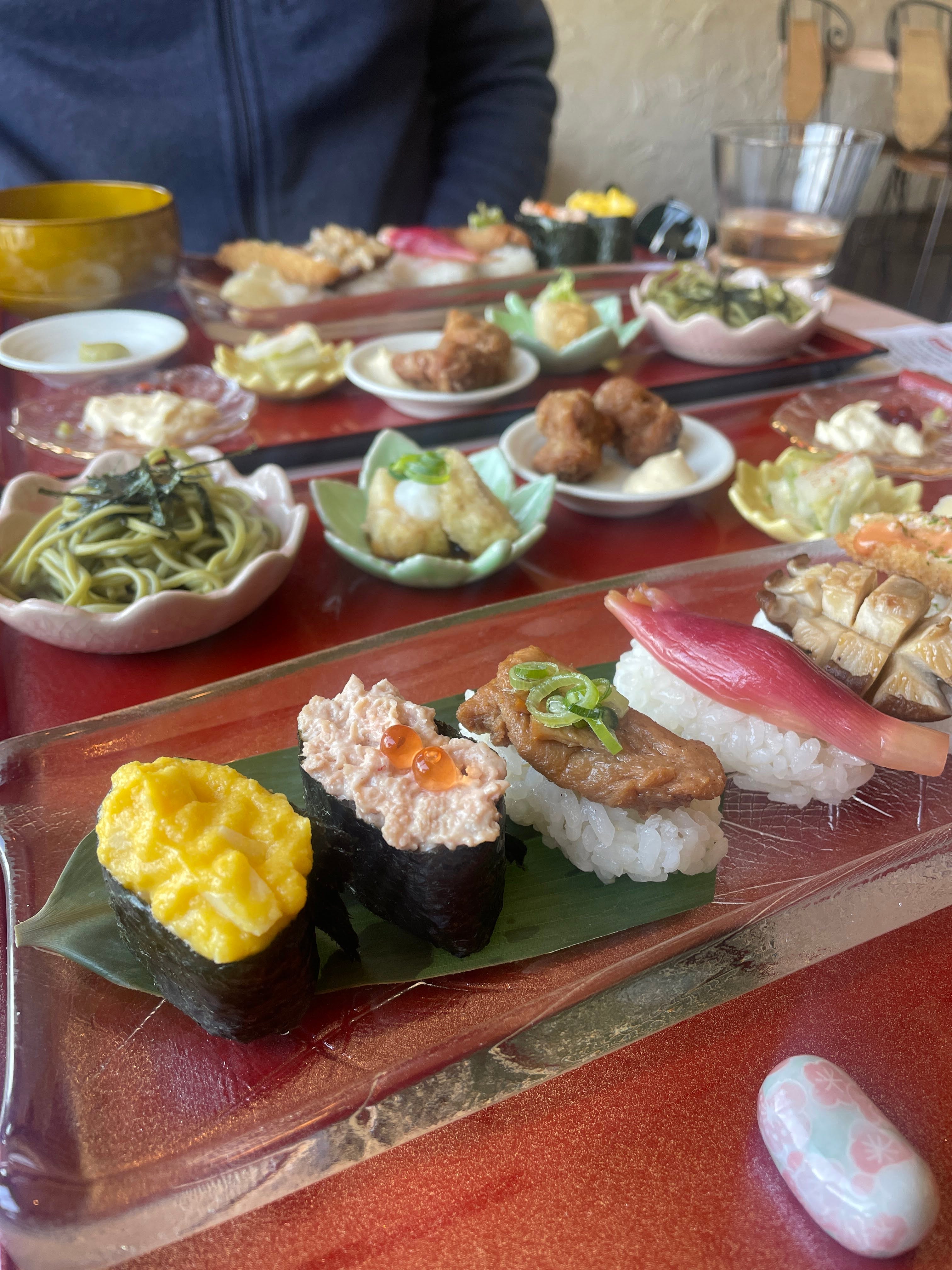
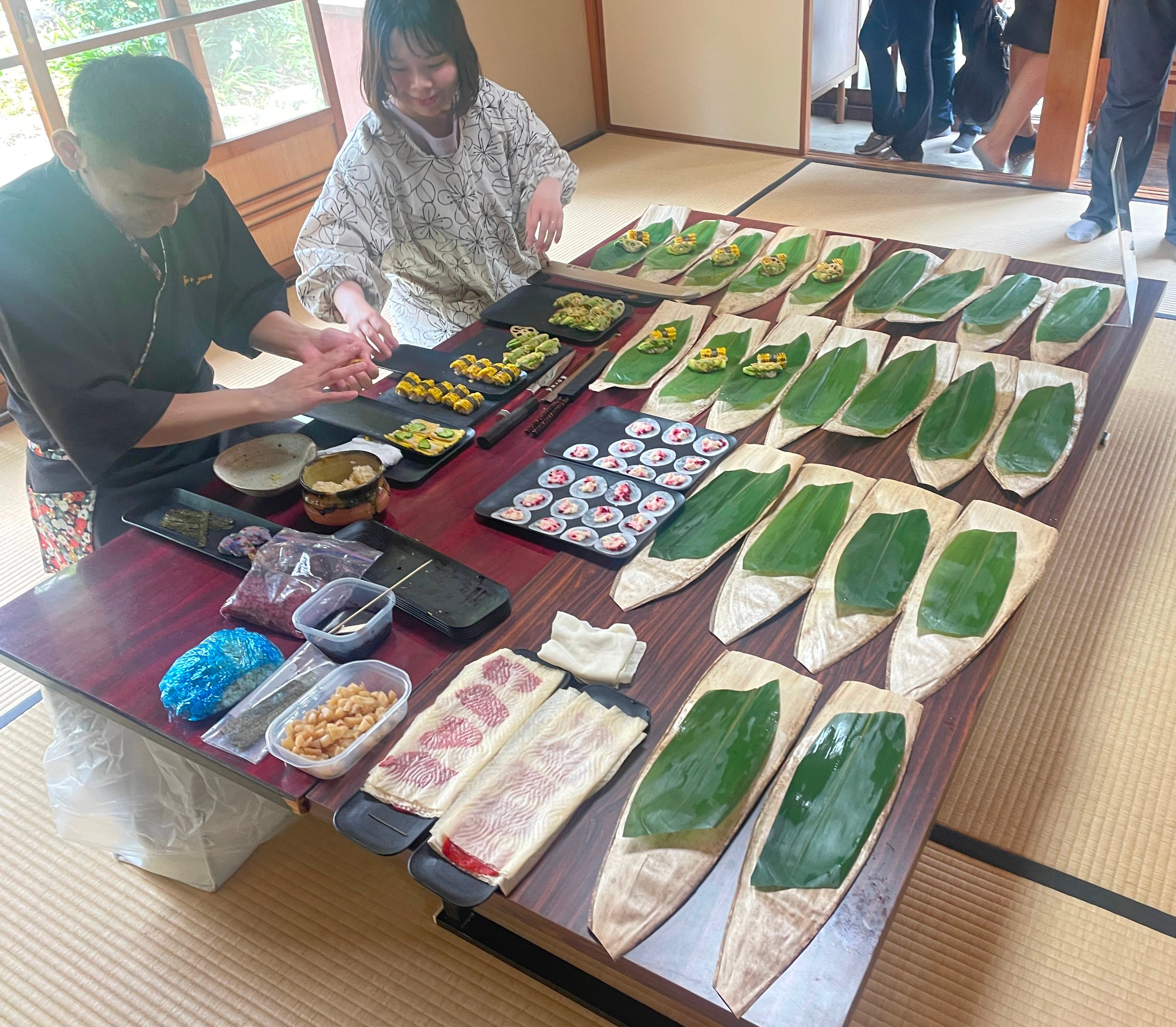
It was when I hosted our first all-inclusive trip to Japan that I realized just how deeply foodie the culture is. I had done some preliminary research through reading history books and watching films such as Jiro Dreams of Sushi and Tampopo, but seeing it firsthand made it all the more clear: the attention to detail, the craftsmanship, the creativity, and the care with which food is prepared and presented.
You see it in the reverence for ingredients, the pride in technique, the blending of tradition with innovation, and the way foods from other cultures are adopted and refined into something distinctly Japanese. (I have so much to share about this!)
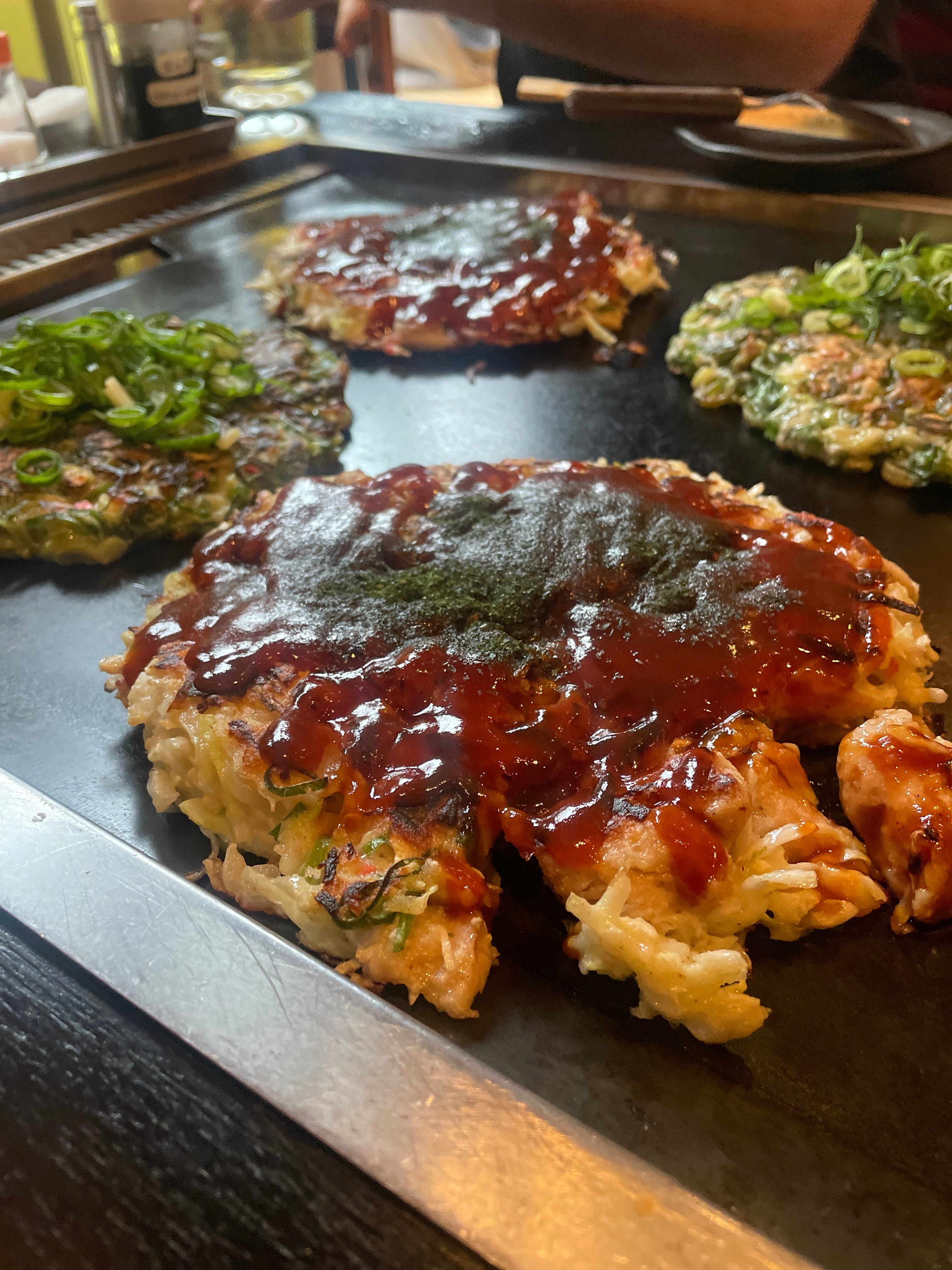
Much of this is easy to see, especially in cities, where many people don’t cook regularly at home. Food culture spills out into the streets — noodle shops, ramen counters, izakayas (casual pubs serving drinks and small dishes), convenience stores, street stalls, and tiny neighborhood restaurants. The result is a vibrancy around food that you feel everywhere.
Those stalls and shops today are filled with all kinds of foods — many plant-based, many not. But the ingredients and traditions behind Japanese cuisine reach back centuries, and that long history helps explain why the cuisine developed the way it did — and why the widespread consumption of meat is a relatively recent development.
Ancient Japan (Prehistoric – 710 CE)
In ancient Japan — from prehistoric times through the establishment of the Nara period in 710 CE — the diet of early inhabitants such as the Jōmon and Yayoi peoples was shaped largely by the natural landscape of the Japanese archipelago.
Like many early societies, people relied on hunting, fishing, and gathering. Aquatic animals from rivers and coastal waters were important sources of food, as were wild animals hunted in forests and mountains.
Plant foods were also central. People gathered nuts such as chestnuts and acorns, wild berries, edible roots, mountain vegetables, and seaweeds.
Rice would eventually become the defining staple of Japanese cuisine, but during these early periods people relied on a diverse range of foods drawn directly from the surrounding environment.
Nara and Heian Periods (710–1185)
Two developments during the Nara and Heian periods profoundly shaped Japanese cuisine:
the expansion of rice cultivation
the spread of Buddhism
…both strongly influenced by China.
RICE: Before rice became dominant, people in Japan cultivated grains such as millet and barley, which were eaten as porridges or mixed with other foods. But rice agriculture, introduced and refined through contact with the Asian mainland, gradually transformed the Japanese diet. Over time, rice became the central staple around which meals were structured — including sushi, whose name comes from a word meaning “vinegared rice.”
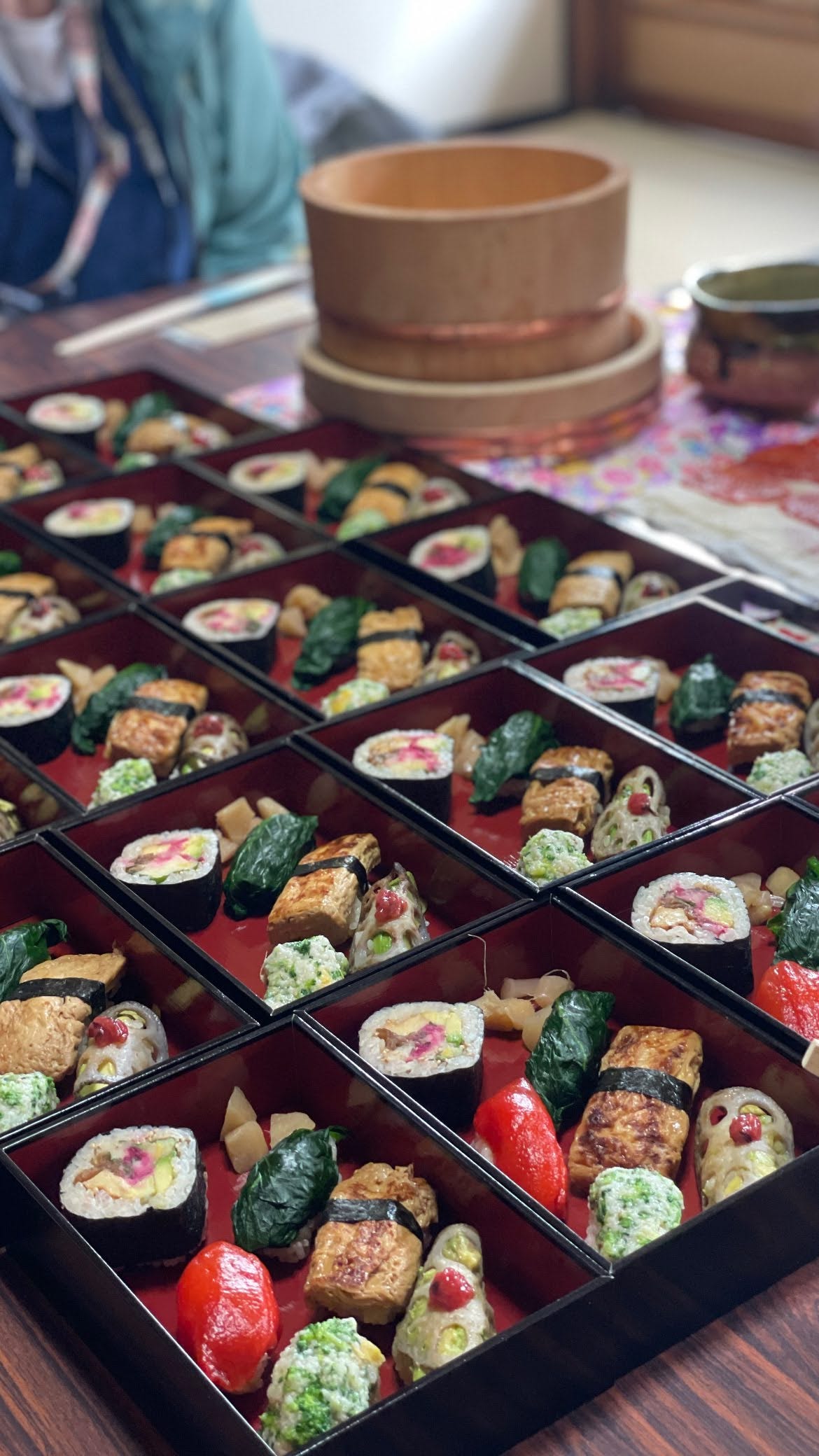
Sushi comes from a word meaning “vinegared rice.” Not fish.
Cultural exchange with China also introduced additional foods that would become fundamental to Japanese cuisine:
Tea — brought by Buddhist monks returning from China, who introduced tea cultivation and preparation (more to come, but start here)
Tofu — a soybean-based food that became an important protein source in a cuisine that often avoided meat (enjoy some recipes here)
Noodles — inspired in part by Chinese culinary traditions, while also evolving in Japan into dishes such as udon, soba, and, later, ramen. (more about ramen here.)
BUDDHISM: Buddhism, introduced to Japan in the 6th century through exchanges with China and Korea, also had a powerful impact on food culture. Because Buddhist teachings emphasize compassion for living beings, the consumption of certain animals was discouraged.
In 675 CE, Emperor Tenmu even issued a decree prohibiting the consumption of several kinds of animals — including cattle, horses, dogs, monkeys, and chickens — during specific months of the year.
For much of this period, everyday meals centered on rice, vegetables, tofu and other soy foods, seaweeds, and seasonal ingredients. In Buddhist temples and aristocratic households, vegetarian cooking became especially refined and formalized, laying the groundwork for what would later become shōjin ryōri, the plant-based cuisine of Buddhist monasteries.
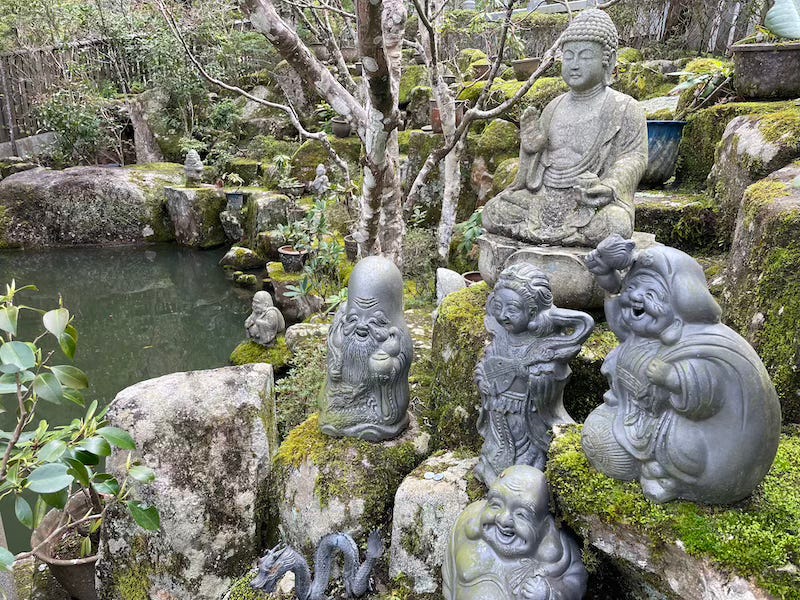
The Kamakura and Muromachi periods (1185-1603) saw the rise of the samurai class and increased trade with China and Korea, which introduced even more new ingredients and cooking techniques. Despite the continued prominence of Buddhist vegetarianism, meat consumption became more common among the general population, especially among the warrior class. Nevertheless, most people continued to eat largely plant-based meals built around seasonal vegetables, tofu, and soy-based foods.
Edo Period (1603–1868)
During the Edo period, Japan experienced long stretches of peace and stability under the Tokugawa shogunate (familiar to anyone currently watching the popular show Shōgun). Cities grew rapidly—especially Edo (modern-day Tokyo)—and with urban life came a vibrant culinary culture.
Street food stalls known as yatai lined busy neighborhoods, offering quick meals to city dwellers. Early forms of sushi were sold from small stands, and tempura—introduced through Portuguese influence but adapted to Japanese ingredients—became a popular dish, originally featuring battered vegetables rather than aquatic animals.
Regional cuisines also began to develop stronger identities, shaped by local ingredients, climate, and cooking traditions. Today, this shows up as a kind of friendly competition among cities like Tokyo and Osaka, each proudly claiming its own specialties and food traditions.
Meanwhile, in Buddhist temples and aristocratic households, vegetarian cooking continued to evolve in complexity and refinement. Elaborate temple meals, rooted in Buddhist principles of non-harm and seasonal simplicity, remained an important part of religious practice.
Yet the Edo period was also the final chapter of Japan’s long era in which animal flesh played only a limited role in the diet of most people.
Meiji Restoration (1868–1912)
The Meiji Restoration marked a turning point in Japanese history. The Tokugawa shogunate was overthrown, imperial rule was restored under Emperor Meiji, and Japan rapidly transformed from a feudal society into a modern industrial nation.
Meat consumption—long limited by religious, cultural, and economic factors—began to spread throughout Japanese society. Sadly, however, this also meant that the habit of eating meat became common throughout Japan.
Prior to the Meiji Restoration, for most people, everyday meals centered on rice, vegetables, soy foods, seaweeds, and seasonal ingredients, along with fish and other aquatic animals. In fact, household consumption of meat—the flesh of land animals—did not surpass that of fresh fish in Japan until 2007.
The Edo period the final chapter of Japan’s long era in which animal flesh played only a limited role in the diet of most people.
Several factors kept meat consumption low for centuries:
RELIGION AND ECONOMICS: Buddhist teachings discouraged the killing of animals, and Japan was largely an agrarian society in which most people were poor rural farmers. Combined with long periods of isolation that limited outside influence, these conditions shaped a diet that remained largely plant-based for most of Japanese history.
ANIMAL FARMING: Unlike many other regions of the world, the rearing of animals for consumption was not widespread in Japan’s history. Most flesh that was eaten historically came from hunting rather than farming, with fish and birds being the more common animal foods. Mammals were increasingly hunted by members of the warrior class, who sometimes feasted on animals such as deer, wild boar, bear, raccoon dog (tanuki), and rabbits.
DUCK FARMING: In the 17th century, the consumption of chicken’s eggs was restricted, influenced by Buddhist beliefs. This led to the emergence of duck farming in southwestern Japan as an alternative. Over time, (all) eggs came to be viewed as a luxury food reserved mostly for the elite. Even after World War II, eggs were still relatively uncommon, but by the 1950s, Westernization of the Japanese diet had made them a common household staple. Today Japan is the world’s second-largest consumer of eggs per capita after Mexico.
Modern Japan (20th Century to Present)
Today, in contemporary Japan, most people consume a diet that includes aquatic animals, land animals, birds’ eggs, and dairy products alongside vegetables and grains.
Aquatic animals remain prominent in Japanese cuisine due to the country’s extensive coastline, while pork and chicken are among the most widely consumed animal flesh. Japanese cuisine has also evolved to incorporate influences from other cultures, including Western foods such as pasta, pizza, hamburgers, and sandwiches.
This shift accelerated after World War II, during the American occupation of Japan, when school lunch programs introduced dairy milk, bread, and meat, normalizing their consumption for a new generation. Dairy, once largely absent from Japanese cuisine, became increasingly common as milk was promoted as a health food.
Television advertisements heavily promote dairy milk consumption, and celebrities often endorse Kobe beef, contributing to the widespread normalization of animal consumption across the population. At the same time, modern diseases such as cancer, diabetes, high blood pressure, and allergies have become increasingly prevalent, leading many individuals to seek medical treatment and rely on medications.
Coming Up: Navigating Japan as a Vegan
This long arc of history reminds us that the modern diet in Japan—and in many parts of the world—is not inevitable.
But if you’re traveling to Japan as a vegan, the real question becomes: what does eating vegan in Japan actually look like?
What ingredients should you watch for?
Which dishes are naturally vegan—or easily made vegan?
How do you navigate menus, language barriers, and cultural norms around modifying dishes?
In the next article, I’ll share exactly that — what to look for, what to avoid, and how to eat joyfully in Japan without feeling stressed or deprived.
That guide — along with my favorite strategies, foods, restaurants, and resources — will be for paid subscribers. If you’ve been thinking about becoming a paid subscriber to support this work and join our community, this series is a perfect time.
Thank you for reading! Please let me know if you have any thoughts to share!

Did you know if you hit the heart ❤️ at the top or bottom of this post, it helps others discover this publication? Thank you in advance! 🙏
Additional Resources
👉 Connect with me 1:1 – Get personalized guidance whatever you are looking for.
👉 Read A Year of Compassion – Daily inspiration to help you live with intention, kindness, and clarity.
👉 Check out my Recipe E-Books and my library of On-Demand Cooking Classes for recipes.
👉 Travel the World Vegan Style! I’ve partnered with World Vegan Travel to bring you the best in luxury, all-inclusive vegan trips around the globe. Whether I am personally hosting or not, every itinerary is curated for a high-quality, premium experience. Check out upcoming trips, and please remember when booking any trip to mention you heard about them from COLLEEN PATRICK-GOUDREAU. 😊